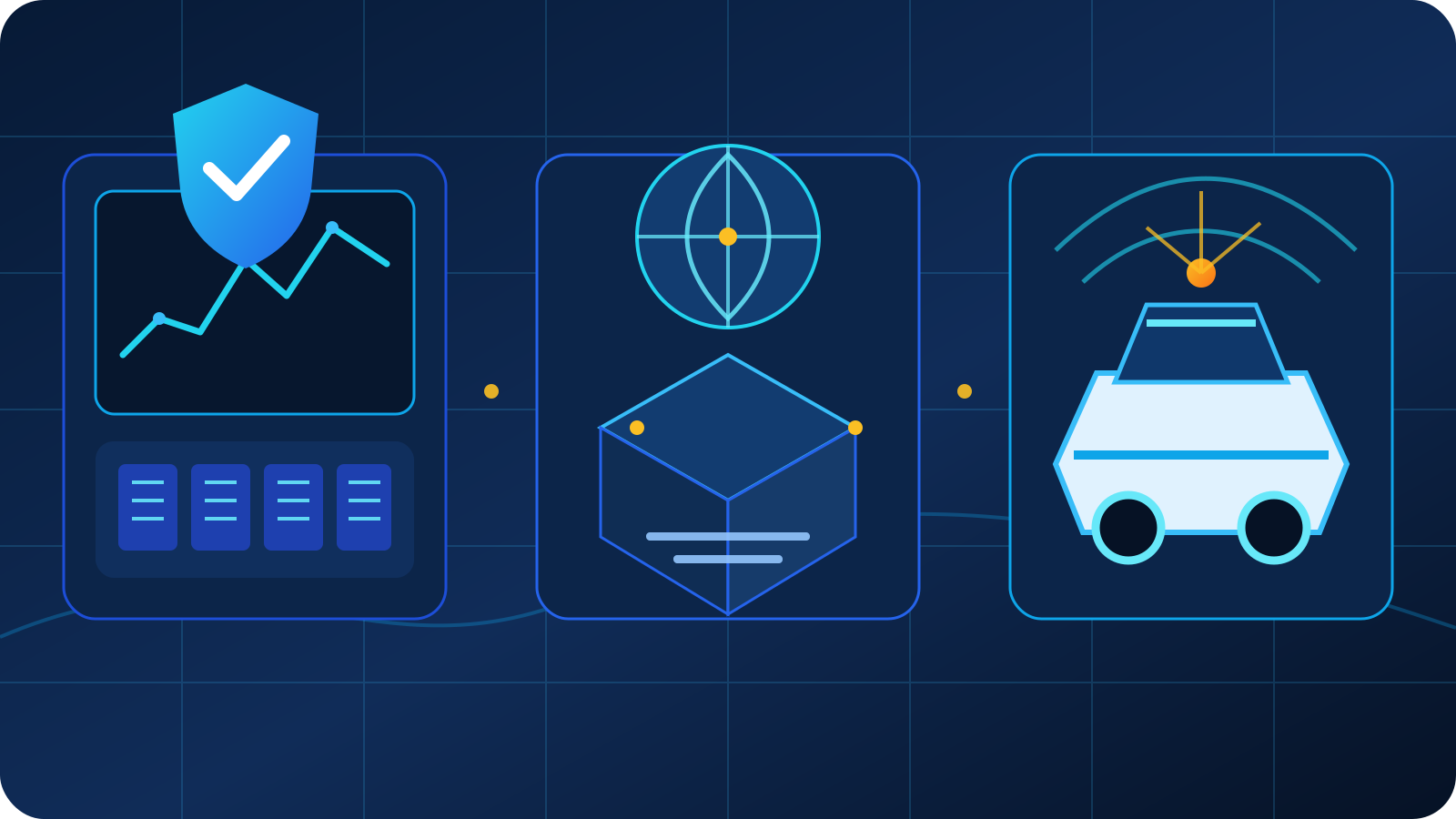
Artificial intelligence is changing both sides of the security equation. It can help defenders find weaknesses faster, but it can also become part of an attacker’s route through an organization. The latest developments on November 3 make that tension concrete, while a new robotaxi simulation system shows how AI is moving into physical-world engineering.
1. UK NCSC sets out an AI-cyber threat outlook through 2028
The UK National Cyber Security Centre (NCSC) has published Artificial intelligence and cyber intrusion, an assessment of current AI-enabled threat trends and three possible scenarios through 2028.
One of its key judgements is that it is highly likely AI-powered malware will have been used in a ransomware attack on UK critical national infrastructure (CNI) between now and 2028. The assessment also judges that Russia, China and other nation states are highly likely to use AI-cyber capabilities routinely by 2028, potentially increasing the scale and speed of sophisticated attacks.
Read the forecast carefully: the NCSC says its scenarios are plausible possibilities, not predictions. The report does not claim that an AI-powered ransomware attack on UK critical infrastructure has already happened.
The assessment highlights the continuing exposure of legacy systems and the possibility that AI-enabled tools will help attackers identify and exploit weaknesses. It also points to new attack surfaces created when organizations connect AI tools to operational environments.
What security teams should do now
- Maintain an accurate inventory of internet-facing and operational technology assets.
- Prioritize patching and mitigation for known vulnerabilities, especially on systems that cannot be replaced quickly.
- Review privileged access, service accounts, remote administration and deployment credentials.
- Test ransomware response and recovery plans, including scenarios where attackers use compromised developer devices.
- Apply least privilege, logging and approval gates to AI tools that can access source code, cloud services or production systems.
2. Binance publishes initial findings on its $6.34 billion security incident
Binance published initial findings on November 3 about the October 29 incident in which attackers gained unauthorized access to an internal wallet-signing service. The company said approximately $6.34 billion in digital assets were affected. Binance also said it would absorb the financial impact rather than pass the loss to users.
The incident report describes a multi-stage intrusion rather than a single AI-driven exploit:
- June: Binance says an employee downloaded a tampered version of a coding tool while setting up an AI coding workflow. The company detected the issue, replaced the device and rotated credentials, but says the employee’s role and related wallet-team access had already been exposed.
- September: A second engineer was targeted through a fake recruitment process. After video interviews with a fictitious company, the engineer downloaded a malicious code repository onto a work computer.
- October 20: Binance says the attacker used the compromised computer together with an internal AI tool to reach the wallet developers’ systems and obtain access to a container deployment token.
- October 29: The attacker used compromised credentials and a deployed container to trigger unauthorized wallet transactions.
The important technical distinction is that the internal AI tool was described as a pivot in a wider compromise, not as an autonomous agent that independently decided to steal funds. The incident involved social engineering, malicious software, compromised endpoints, credential access and wallet-authorization weaknesses.
Binance reported that approximately 98% of affected token assets had been replenished as of October 31 and that about $2.85 billion had been frozen or intercepted. Those recovery figures and the commitment to cover the loss are Binance’s own statements; the investigation and independent review remain ongoing. Reuters separately reported the fake-interview and internal-AI-tool details on November 3.
Security lessons for teams using AI coding tools
- Install developer tools only from verified vendor sources and validate package signatures or checksums where available.
- Keep AI assistants away from production credentials unless access is essential, scoped and monitored.
- Separate development, deployment and signing permissions so one compromised workstation cannot control an entire transaction path.
- Use phishing-resistant authentication and endpoint monitoring for engineers with privileged access.
- Revoke tokens and sessions quickly after a suspected device compromise, then verify that downstream authorizations are also invalidated.
3. OpenAI expands its defensive security work and outlines a grid-flexible data-center program
OpenAI announced two different initiatives on November 2. The first is a planned internal security sprint with external research partner Cathedral. OpenAI says the partner will use its models alongside OpenAI teams to challenge defenses, find weaknesses and test fixes. The company also said it is increasing rewards for critical findings in its Security Bug Bounty program by more than four times.
This is a defensive use of frontier models: the stated goal is to identify and remediate weaknesses before attackers exploit them. The announcement describes a planned sprint and a company-run bug bounty change; it is not an independent assessment of OpenAI’s security posture.
Separately, OpenAI introduced its Grid Protectors Program, which aims to make future compute campuses reduce electricity demand when local grids are under strain. For a planned campus in Effingham County, Georgia, OpenAI says its agreement with Georgia Power includes up to 1,000 megawatts of flexible demand response. The company compares that capacity with the average electricity demand of roughly 700,000 households.
The Georgia campus is still in development, and the demand-response arrangement is a planned capability rather than a demonstrated result from an operating site. The broader issue is increasingly important: AI infrastructure needs more electricity, and large data-center operators will face growing pressure to fund the grid capacity they require and avoid shifting costs to local customers.
4. Baidu launches Apollo World for robotaxi simulation
Baidu launched Apollo World on November 3, according to Reuters. The system is designed to simulate road environments for autonomous-driving training and predict how those environments change. It can generate multimodal sensor streams, including camera and LiDAR observations, so self-driving systems can practice perception and navigation in simulated scenes.
Baidu said Apollo World can generate up to 100,000 kilometres of simulated driving per day, which it compared with about three years of real-world testing by a vehicle operating with a safety driver. Reuters reported that Baidu is already using the system to train its Apollo Go robotaxi fleet.
The daily-distance figure is a company-reported capacity claim, not an independently verified safety benchmark. Simulated kilometres can help engineers test rare situations repeatedly, but they are not interchangeable with public-road miles, regulatory approval or proof that a vehicle is safe in every real-world condition.
Why simulation matters
Autonomous-driving teams need to test unusual but consequential events: a pedestrian emerging from behind a parked vehicle, an emergency vehicle approaching an intersection, a sudden lane obstruction or sensor performance in poor weather. Simulation can make such scenarios repeatable and reduce the time needed to expose software to edge cases.
The engineering challenge is the transfer from simulation to reality. A useful world model must represent sensor noise, road behaviour and unexpected events well enough that improvements in the virtual environment also improve performance on actual roads. Real-world validation and safety oversight remain essential.
What these developments mean for AI teams
| Development | What is confirmed | What remains uncertain |
|---|---|---|
| NCSC AI-cyber assessment | Published threat scenarios and likelihood judgements through 2028. | These are plausible future scenarios, not a claim that every scenario has occurred. |
| Binance incident | Binance disclosed a multi-stage compromise and its initial recovery figures. | The investigation and independent review are still ongoing. |
| OpenAI security sprint | OpenAI announced an external research partnership and higher critical bug-bounty rewards. | The results of the planned sprint have not yet been published. |
| Baidu Apollo World | Reuters reported the launch and Baidu’s description of the simulation system. | The headline simulated-distance figure is a company claim, not a safety certification. |
What to watch next
- Critical infrastructure: whether operators turn the NCSC assessment into measurable patching, segmentation and recovery improvements.
- AI supply-chain security: whether organizations restrict AI coding tools and developer endpoints from reaching high-impact production systems by default.
- Defensive AI: whether OpenAI and other vendors publish independently reviewable evidence that model-assisted security testing finds and fixes vulnerabilities effectively.
- AI infrastructure: whether grid-flexible data-center agreements deliver measurable benefits once campuses are operating.
- Physical AI: whether simulation-generated scenarios improve robotaxi safety outcomes in independent real-world testing.
Frequently asked questions
Does the NCSC say AI-powered ransomware has already hit UK critical infrastructure?
No. The assessment says it is highly likely AI-powered malware will have been used in a ransomware attack on UK CNI by 2028. Its scenarios are plausible possibilities, not predictions or confirmation of a completed attack.
Was the Binance incident an autonomous AI attack?
Binance’s initial findings describe a multi-stage compromise involving malicious downloads, social engineering, compromised computers, credentials and wallet services. The company says an internal AI tool was used as part of the attacker’s route through the organization; that is not the same as an autonomous AI agent carrying out the theft on its own.
What did OpenAI announce for cybersecurity?
OpenAI announced a planned security sprint with external researchers and said it would more than quadruple rewards for critical findings in its Security Bug Bounty program.
Does Apollo World replace real-world robotaxi testing?
No. Simulation can expand test coverage, but its results must be validated against real driving data and complemented by safety testing and regulatory oversight.
Sources and further reading
- UK National Cyber Security Centre — Artificial intelligence and cyber intrusion
- Binance — Initial findings on the October 29, 2026 security incident (November 3)
- Reuters — Binance hackers used fake job interview to compromise computer before $6.3 billion attack (November 3)
- OpenAI — Preparing our next security sprint to harden OpenAI (November 2)
- OpenAI — Introducing the Grid Protectors Program (November 2)
- Reuters — China’s Baidu launches AI model simulating road environment for robotaxis (November 3)
Conclusion
Today’s news shows why AI security must be treated as an operational discipline, not just a model-safety topic. The same organization may need to defend against AI-assisted intrusions, use AI to find its own vulnerabilities and manage the power demands of the infrastructure that runs its models. Across all of these areas, clear permissions, independent validation and accountable human decisions remain essential.