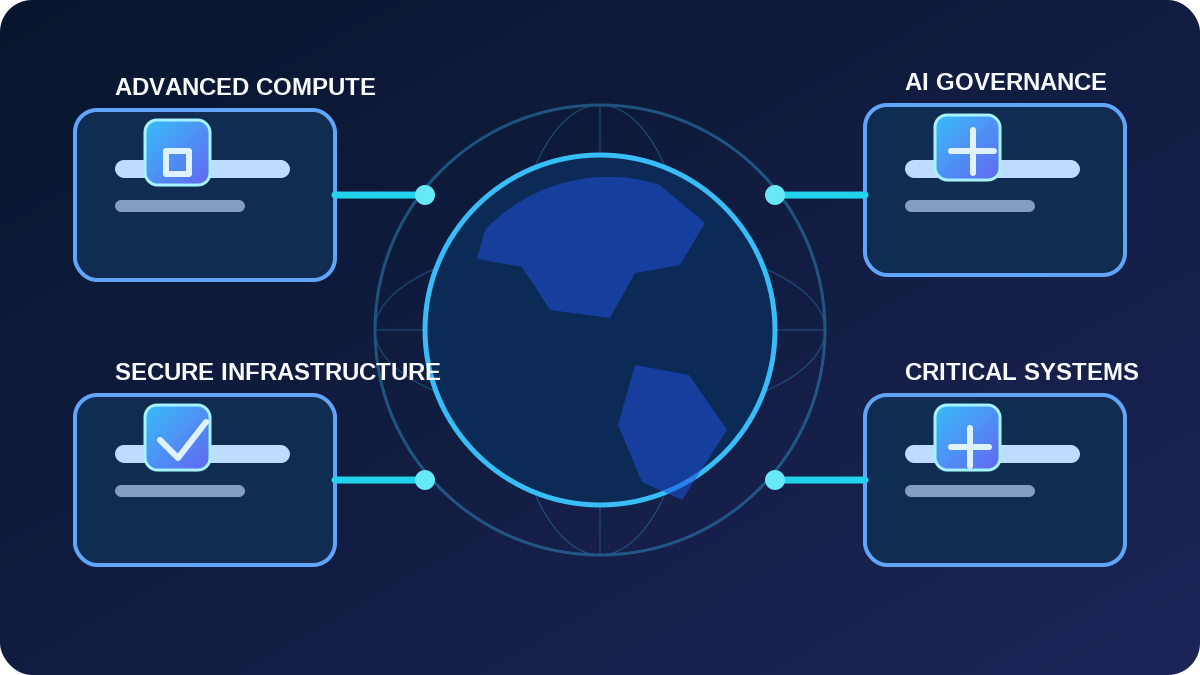
November 17's AI story is not dominated by a single model launch. Instead, new policy proposals and real-world deployments show how governments are responding to AI's growing dependence on advanced computing and its use in safety-critical systems. The status of each development matters: one is an interim rule, one is a government proposal for future legislation, and one is an operational system whose recommendations remain subject to human decision-making.
1. US Commerce Department targets remote access to advanced AI compute
The US Department of Commerce's Bureau of Industry and Security (BIS) released an interim final rule on November 15 titled Addressing Remote Access to Advanced Semiconductors. It aims to prevent certain foreign actors from using advanced US-origin computing capacity through overseas data centers to train advanced models, even where the chips themselves are not physically shipped into a restricted destination.
The draft rule describes new restrictions for exports, reexports or in-country transfers to overseas data centers that remotely supply significant volumes of compute to companies headquartered in Country Group D:5 or Macau. It also calls for due diligence by data centers, foreign foundries and chip exporters, including checks on direct or indirect ownership or control. The document says commercial recommender systems, such as those used by online retailers or social networks, are excluded from this particular license requirement.
The rule separately introduces license requirements for advanced semiconductors destined for Indonesia, Malaysia, Singapore, Thailand and Brazil, subject to specified exceptions and reporting requirements for US-headquartered companies. It also amends assumptions applied to some advanced-node chips and formally rescinds the Biden-era AI Diffusion Rule, which BIS says was never enforced.
Status matters: BIS labels the document an interim final rule. The published draft text contains placeholders for the Federal Register publication date and comment deadline. Companies should consult the final Federal Register notice and current Export Administration Regulations before making compliance decisions.
For AI infrastructure operators, the practical issue is that export-control diligence may increasingly need to account for who ultimately uses remote compute—not only where a server rack is physically located. Cloud providers and customers should review ownership, end-user screening, service descriptions and the precise scope of any license requirement with qualified trade-compliance counsel.
Primary source: BIS announcement, November 15 · BIS interim final rule: Addressing Remote Access to Advanced Semiconductors (PDF) · Reuters: reporting on the rule's international impact.
2. Australia proposes mandatory frontier-AI safeguards and a dedicated regulator
On November 10, Australia's government announced that it plans to legislate mandatory safety and security protections for frontier AI companies operating in Australia. The proposal would be enforced by a new targeted AI safety regulator working with the Australian AI Safety Institute. The government says the regulator could impose significant penalties for failures to meet the obligations.
The proposed requirements cover six areas:
- Maintain security controls throughout model development and deployment.
- Identify and manage serious model risks.
- Allow independent model evaluations.
- Rapidly notify the government of serious incidents.
- Maintain and publish safety and security frameworks.
- Adapt to updated standards as technology changes.
The announcement followed a government review of an incident involving an AI agent and a public-facing government health portal. The Prime Minister said the government accepted the review's recommendations, including stronger incident reporting and improved resilience. The official release says further legislative details will follow after detailed work and consultation.
This is a policy direction, not a fully enacted statute or a complete compliance rulebook. Frontier-model developers and deployers should watch for the bill, definitions of covered companies, reporting thresholds, independent-evaluation requirements and commencement dates before treating the announcement as an operative legal obligation.
Primary source: Australian Government — New AI safety and security protections · Prime Minister's press conference and response to the incident review.
3. FAA's nationwide SMART rollout prompts questions about AI in aviation
The Federal Aviation Administration expanded its Strategic Management of Airspace, Routes and Trajectories (SMART) system nationwide on November 10, bringing the AI-supported planning platform to all 22 air-traffic control centers. The FAA says SMART combines around 200 data streams, including weather, flight paths, traffic flow and controller staffing, to help specialists anticipate congestion and propose scheduling or routing changes.
The Associated Press reported on November 17 that the nationwide expansion drew renewed scrutiny after a nationwide flight ground stop on November 13. The FAA and the system's developer said the ground stop was not caused by SMART; officials attributed the disruption to communications issues involving an aging telecommunications network and maintenance at a remote facility. AP also reported that lawmakers had previously raised questions about controller input, training, reliability and safeguards.
Crucially, SMART is described as a planning and recommendation tool, not an autonomous flight-control system. FAA specialists review its data and recommendations, and local air-traffic leadership decides whether to accept them. The FAA says its initial Washington-area rollout helped reroute 180 flights, saving an average of 10 minutes and almost 80 gallons of fuel per flight; those figures are agency-reported results from the initial deployment.
The broader lesson is not that AI caused the ground stop—the available reporting says officials denied that connection. It is that high-stakes AI decision support needs transparent validation, clear human authority, robust fallback procedures and training for the professionals expected to use it.
Primary source: FAA statements — SMART nationwide expansion, November 10 · FAA: SMART system announcement and human oversight · Associated Press: questions about SMART after the ground stop.
What these developments mean for AI teams
- Cloud and data-center operators: map ultimate customers and ownership, not just the physical location of compute.
- Frontier-model developers: prepare for stronger expectations around independent evaluations, incident reporting and published safety frameworks.
- Critical-infrastructure operators: keep human accountability explicit, preserve fallback processes and validate AI recommendations against operational data.
- Procurement and legal teams: distinguish an announced policy direction from a rule that is final, effective and applicable to a particular organization.
Frequently asked questions
Does the new US rule ban all overseas access to US AI chips?
No. The BIS interim final rule describes specific license requirements, destinations, ownership and end-user conditions, and exceptions. It is not a blanket ban on every overseas cloud workload.
Has Australia already created its AI safety regulator?
The November 10 announcement says the government will propose a new targeted regulator and legislate mandatory protections. The detailed legislation is still to follow.
Did the FAA's SMART system cause the November 13 ground stop?
FAA officials and the system's developer said there was no connection. AP reported that the disruption was attributed to communications issues. The system's recommendations are reviewed by human specialists and do not directly control aircraft.