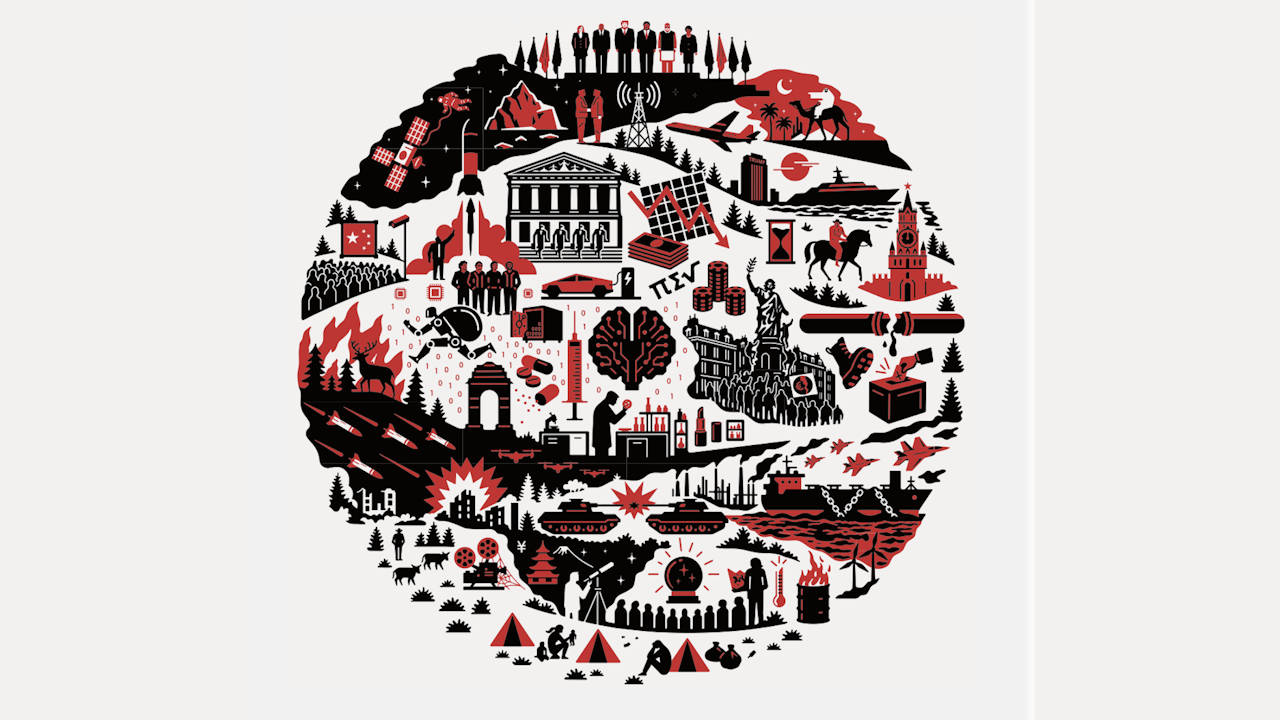
Every year, The Economist publishes The World Ahead, an annual look at the forces likely to shape the next twelve months. Its 2027 edition brings together ten themes spanning political leadership, war, energy, financial markets, emerging technology, healthcare, space and popular culture.
The cover is designed as an editorial illustration, not a coded forecast in which every object has one official meaning. The magazine’s own launch announcement is the best guide to its stated themes. The analysis below separates those editorial expectations from what readers should monitor as events unfold. These are scenarios and risks to watch—not guaranteed predictions.
1. The post-Trump era begins before the presidency ends
The first theme is the political transition already taking shape around the next US presidential race. The Economist expects Donald Trump to remain an assertive and unpredictable political force rather than quietly retreating into a conventional lame-duck role. Executive actions, legal disputes, foreign policy decisions and attempts to shape his legacy could all influence the political environment.
For other countries, the question is how to plan for a future America while managing the policies of the current administration. Allies may seek more strategic flexibility, while businesses may need to account for changing trade, technology and security rules.
2. The aftershocks of the Iran war could reach far beyond the region
The second theme is the regional and global impact of the Iran conflict. The Economist highlights the possibility of altered alliances, disrupted energy routes and pressure on food supplies if fertiliser becomes scarce. These channels matter because energy and agricultural inputs are traded internationally: a regional shock can feed into transport costs, farm economics, food prices and inflation elsewhere.
For households and companies, the practical indicators to watch include oil and gas prices, shipping and insurance costs, fertiliser availability, and the policy responses of major energy importers. The precise outcome remains uncertain; the key point is that geopolitical risk can travel through supply chains.
3. Climate extremes and energy security will be linked
The magazine expects 2027 to bring another year of severe heat, droughts, wildfires and other climate stresses, with the possibility of a very strong El Niño adding to the risk. Seasonal climate patterns do not affect every region in the same way, and forecasts should be updated as the year progresses.
One important connection is between climate policy and energy security. Renewable power can reduce exposure to volatile imported fossil-fuel prices as well as cut emissions. That does not remove the need for reliable grids, storage, transmission and backup capacity, but it makes the energy transition a question of economic resilience as well as environmental policy.
For background, see the World Meteorological Organization for global climate monitoring and the International Energy Agency’s renewable-energy analysis.
4. Artificial intelligence faces a tougher public and financial test
AI is no longer discussed only as a productivity opportunity. The Economist points to a growing backlash as concerns about political influence, cyber risk and the financial structure of the AI boom become harder to ignore. A particular issue is the use of debt and complex arrangements to finance large infrastructure and model-development investments. If expectations outrun revenue or financing conditions tighten, a market correction could affect more than technology companies.
At the same time, increasingly capable AI systems create real security questions. Organisations will need to think about model access, data leakage, automated attacks, supply-chain dependencies and the ability to audit systems used in important decisions. The right response is neither uncritical adoption nor blanket rejection: it is careful evaluation, clear accountability and security controls proportionate to the risk.
Businesses adopting AI should document where models are used, what data they can access, how outputs are checked and what happens when a system fails. For a practical starting point, explore our Website Safety Checker when reviewing the security posture of a public-facing website.
5. Europe’s populist right could reshape the EU’s political balance
The fifth theme focuses on France and the possibility of a major political shift if Marine Le Pen’s movement wins the next presidential contest. France is central to the European Union’s political and economic architecture, particularly its partnership with Germany. A change in direction in Paris could influence debates over European integration, fiscal policy, migration and the bloc’s strategic priorities.
The outcome is not predetermined. Election rules, candidate eligibility, party alliances, turnout and economic conditions can all change the political picture. The broader issue is how domestic political movements can affect institutions and markets well beyond national borders.
6. Government borrowing and bond markets may become a stress point
Another concern is the level of public debt in wealthy economies. When investors demand higher yields to hold government bonds, borrowing becomes more expensive for governments and can also influence mortgage rates, business financing and the cost of servicing existing debt. Countries with large refinancing needs or weak fiscal credibility may be more exposed to sudden changes in market sentiment.
Bond-market pressure is not automatically a crisis. Governments have different debt structures, currencies, central-bank arrangements and fiscal options. But the interaction between higher interest costs, slower growth and political resistance to spending cuts or tax increases is worth watching. The International Monetary Fund’s financial-sector research provides useful context on financial stability and market vulnerabilities.
7. Taiwan remains a major flashpoint in the Indo-Pacific
The Economist identifies Taiwan as a point of heightened strategic risk in 2027. The issue combines military planning, regional alliances, semiconductor supply chains and the changing economics of modern warfare. Drones, precision weapons, cyber capabilities and lower-cost systems can complicate the calculations of larger military powers, but they do not eliminate the danger of escalation.
It is important to distinguish a reported military readiness target from a confirmed decision to launch an attack. Readiness, political intent and the ability to conduct a complex operation are different things. Businesses with exposure to semiconductor manufacturing, shipping or electronics supply chains should nevertheless consider how a disruption in the Taiwan Strait could affect production and delivery times.
8. Weight-loss medicines could reshape consumer markets
The “Ozempic effect” is the edition’s reminder that medical innovation can have consequences far beyond healthcare. GLP-1 medicines and related treatments may influence demand for food, clothing, cosmetics, fitness services and other consumer categories. The magazine also points to renewed interest in longevity research as pharmaceutical companies explore treatments associated with healthier ageing.
The commercial effects will depend on access, affordability, clinical evidence, long-term safety and how widely these medicines are prescribed. It is too early to assume that every predicted shift in consumer behaviour will happen at the same speed or scale. The important trend is that a change in healthcare can alter spending patterns across multiple industries.
9. Cheaper space launches could open new commercial possibilities
The ninth theme looks upward. If launch costs fall and reusable rockets become more operationally reliable, more satellites, commercial stations and specialised services could become economically viable. The Economist also highlights the idea of placing data centres in orbit. That remains an ambitious concept, with engineering, maintenance, radiation, cooling, bandwidth and launch economics still to solve.
Lower launch costs could support Earth observation, communications, navigation and scientific research even without orbital data centres becoming practical in the near term. The milestones to watch are flight frequency, payload cost, reliability and whether commercial customers can build sustainable business models around the new capacity.
10. Hollywood faces a question of relevance, not just franchises
The final theme turns to entertainment. Established film franchises are seeking to attract new audiences, while creator-led productions and lower-budget films demonstrate that viewers can discover stories outside the traditional studio system. The challenge for Hollywood is not simply whether a familiar character or universe can return, but whether a new release offers a reason to care.
The wider lesson applies to other industries too: distribution advantages and established brands matter, but they do not guarantee attention. Audiences have more choices, and creators can reach communities directly through digital platforms.
What connects the ten themes?
Several threads run through the list. First, geopolitical shocks can become economic shocks through energy, food, shipping and technology supply chains. Second, AI is simultaneously an innovation story, a cybersecurity issue and a question about how capital is allocated. Third, public finances and borrowing costs may limit governments’ ability to respond to crises. Finally, new technologies—from renewable power to reusable rockets and medical treatments—can create opportunities, but only when the supporting infrastructure and institutions keep pace.
For readers and business owners, the most useful approach is to monitor leading indicators rather than treat any annual outlook as a fixed script. Watch policy announcements, market pricing, supply-chain data, climate updates and actual product adoption. Revisit assumptions when new evidence arrives.
Frequently asked questions
What is The Economist’s The World Ahead 2027?
It is the magazine’s annual special report examining issues and developments that its editors and contributors believe could shape the coming year. The 2027 edition covers ten themes across politics, conflict, climate, AI, finance, healthcare, space and entertainment.
Are the cover images confirmed predictions?
No. The cover is an editorial illustration. The Economist’s published list of ten themes is a more reliable guide to the topics the edition intends to explore. Individual interpretations of every symbol should be treated as speculation unless the publisher confirms them.
Which 2027 trends could affect everyday costs?
Energy and fertiliser disruption, climate-related food pressures and higher government borrowing costs could influence prices and financing conditions. The impact will vary by country and by how events develop.
Does the AI outlook mean an AI crash is certain?
No. It identifies financial and security risks, not a guaranteed market collapse. Investment returns will depend on adoption, revenue, costs, competition and financing conditions.
Sources and further reading
- The Economist Group: official launch and the ten themes of The World Ahead 2027
- World Meteorological Organization: climate monitoring and updates
- International Energy Agency: renewable energy analysis
- International Monetary Fund: financial-sector and stability research
Editorial note: This article is an independent summary and analysis of themes publicly announced by The Economist. It is not affiliated with or endorsed by The Economist. Forecasts describe possibilities and risks, not certainties. Readers should consult primary sources and current data before making financial, political or business decisions.